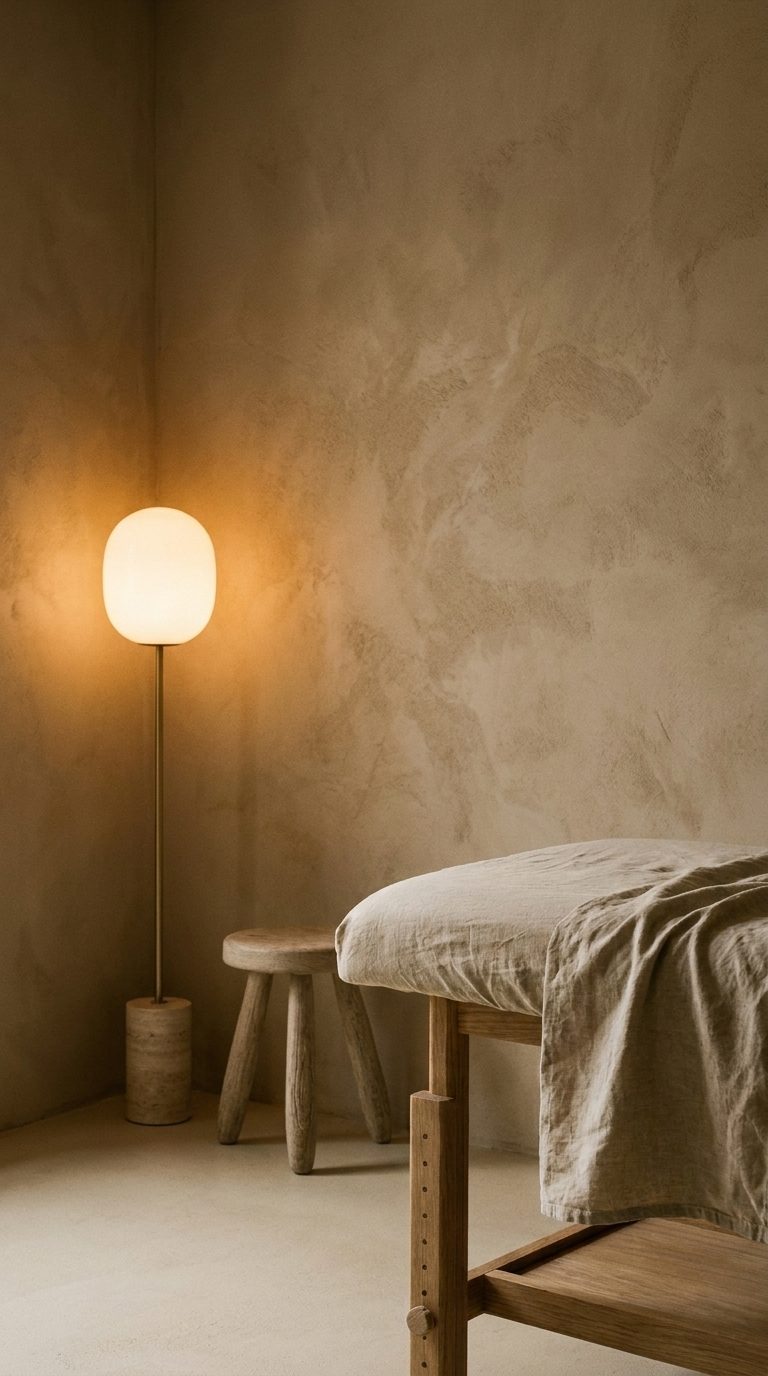
What happens to the body
while you sit
Find your state below
If the pain is sharp, you feel dizzy, or it is hard to breathe even sitting — see a doctor, not this page.
The body
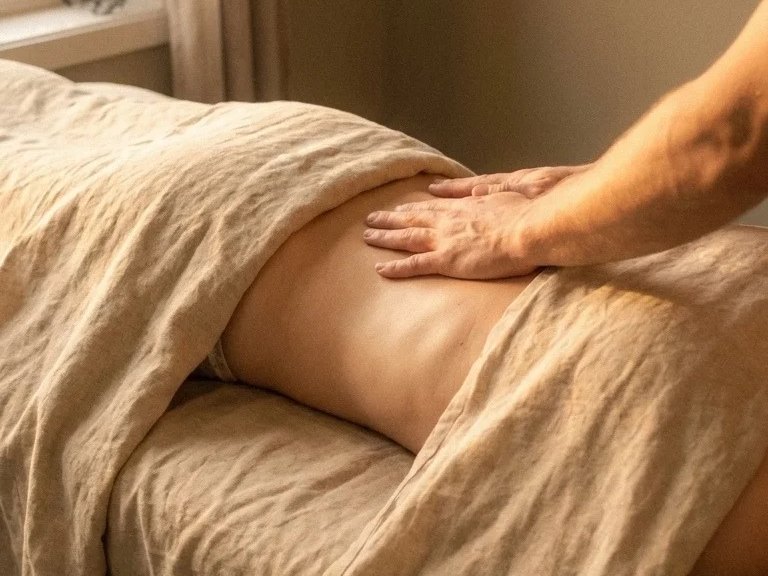 Stiff lower back from sitting
40 seconds · sitting
What to do →
Stiff lower back from sitting
40 seconds · sitting
What to do →
- Sit on the edge of the chair, feet flat on the floor.
- Slowly rock the pelvis forward — and let it come back. The movement is small, barely visible to the eye.
- Five or six times, without effort. The back finds by itself where to let go.
What I see at the table
Under my fingers the muscle along the low back feels like sealing wax that has set. It holds the whole weight of the torso while the arms reach forward to the keyboard. The tissue is not in spasm — it is simply tired of holding the line alone.
If it wakes you at night and the morning is worse than the evening was — see a doctor. The observation leans on work by Kett, 2021
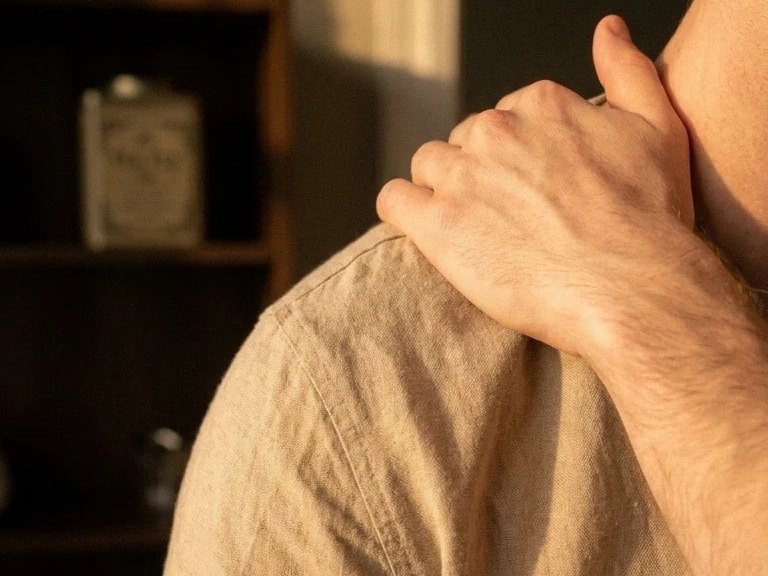 Shoulders up to the ears
40 seconds · sitting
What to do →
Shoulders up to the ears
40 seconds · sitting
What to do →
- Put your palms on the table.
- On the exhale press the palms down — and release after four seconds.
- The shoulders drop by themselves. Three times, between tasks.
What I see at the table
A person lies down on the table, and the shoulders stay up by the ears — as if a jacket had been left on its hanger. The upper trapezius feels like a tensioned steel cable: for hours it keeps the head from falling into the monitor, and it has simply forgotten how to come down on its own.
If lowering the shoulder sends a sharp shooting pain into the fingers, or the neck has locked — see a doctor. The observation leans on work by Szeto, 2005
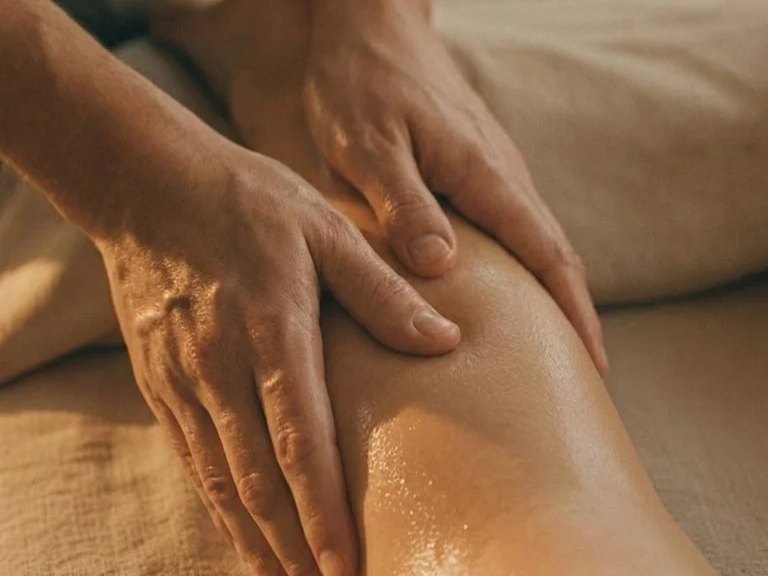 Legs heavy by evening
60 seconds · sitting or standing
What to do →
Legs heavy by evening
60 seconds · sitting or standing
What to do →
- Curl your toes for five seconds — and release.
- Shift your weight onto the heels, lifting the toes off the floor.
- Pull the foot firmly towards you. Ten rolls.
What I see at the table
The body often holds water in the tissues for weeks, and that creates a false sense of extra weight. When the fluid leaves, the legs stop feeling like lead.
If the swelling is in one leg only, or comes with heat or a sharp bursting pain — see a doctor. The observation leans on work by Ludbrook, 1966
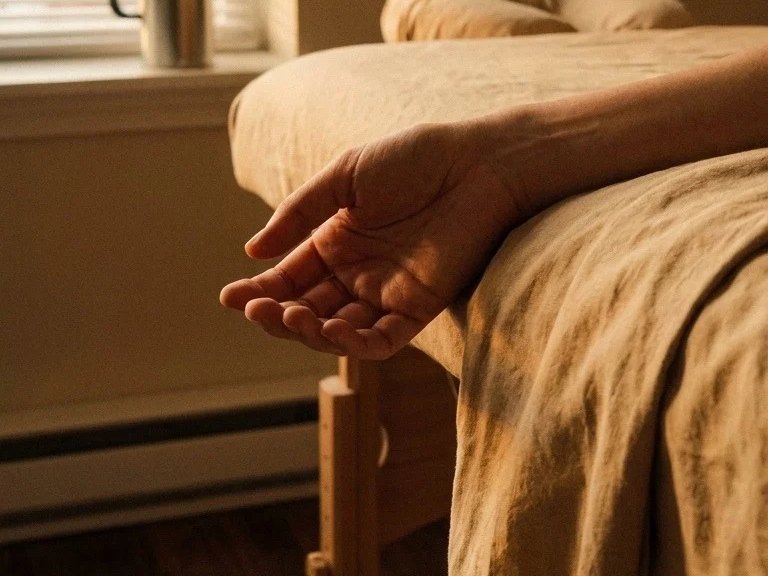 The hand stops feeling light by evening
40 seconds · sitting
What to do →
The hand stops feeling light by evening
40 seconds · sitting
What to do →
- Take the muscular pad between your thumb and index finger, using the thumb and index of the other hand.
- Slowly, without a jerk, sink the finger in and hold an even pressure for forty seconds, breathing calmly.
- Then the other hand.
What I see at the table
I take that hand with almost everyone. Not because anyone asked — when a person lies down the hand is simply there, and I take it. And almost always there is a knot in it. The person does not know about it. They came in for their neck.
If numbness in the fingers stays, if things fall out of your hands, if you have lost the sense of hot and cold — see a doctor.
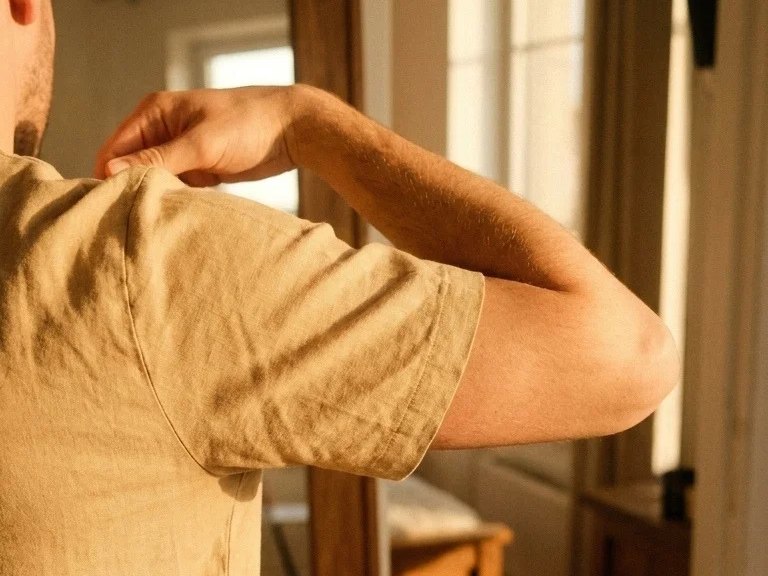 A burning spot between the shoulder blades
A minute · standing at a wall
What to do →
A burning spot between the shoulder blades
A minute · standing at a wall
What to do →
- Press a ball to the wall next to the sore spot — about a palm to the side, closer to the spine or higher.
- Look not for pain but for a response: the point where pressing echoes in that same familiar place.
- Having found it, do not roll. Leave your body weight on it for thirty to forty seconds and breathe calmly.
If pain shoots down the arm to the fingers, if you cannot lower your chin to your chest, if numbness stays after you have stepped away from the wall — see a doctor.
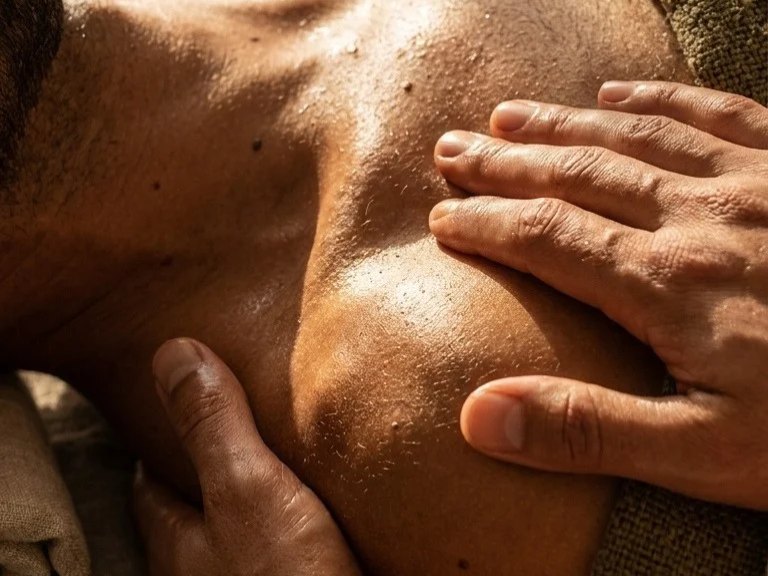 The face is heavy in the morning
A minute · sitting
What to do →
The face is heavy in the morning
A minute · sitting
What to do →
- Cross your palms so that the fingertips land in the hollows above the collarbones.
- Breathe in through the nose. On a long exhale simply let the weight of your hands rest on the collarbones. Do not press the fingers in and do not move them. If your arm goes numb or tingles, take your hands away.
- Five breaths.
What I see at the table
When people ask me to do something about the face, I do not put my hands on the face. First on the collarbones. There, in the hollows above the bone, it is dense by evening in almost everyone: the shoulders stayed a little higher than they needed to all day, and the hollows closed.
If swelling comes suddenly and holds half the face, if dense nodes sit in the skin of the neck — see a doctor. Swelling of the lips or the throat with difficulty breathing calls for an ambulance, not a massage.
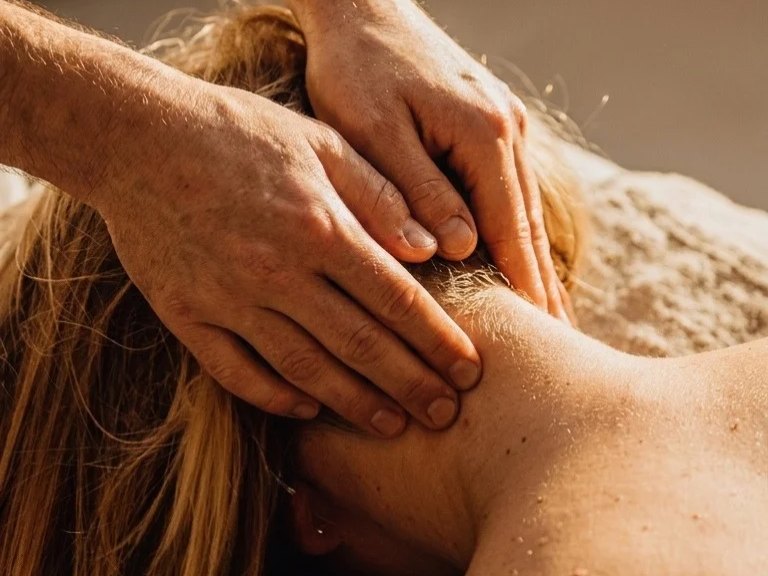 A brick under the back of the head by evening
A minute · sitting
What to do →
A brick under the back of the head by evening
A minute · sitting
What to do →
- Sit back against your chair. Lace your fingers under the base of your skull and let your head rest in your palms.
- Close your eyes. Breathing in, move your eyes up under closed lids. On a long breath out, move them down.
- Keep your head still. Five times.
Don't: pull your head down with your hands, press your fingers into the back of your head. If one eyelid suddenly droops, you see double, part of your vision goes missing, or you get the worst headache of your life out of nowhere, get emergency help. Puffiness around the eyes is one for your doctor. If it hurts, stop. Not for you if your neck hurts for no clear reason, after a recent neck or head injury, or if lacing your hands behind your head hurts your shoulders.
 The voice is gone by Friday
one minute · sitting
What to do →
The voice is gone by Friday
one minute · sitting
What to do →
- Lips closed, teeth apart, jaw loose.
- On a long out-breath, a quiet "mmm" for about ten seconds.
- Six times. Keep your shoulders down.
What I see at the table
By the end of the week my own voice goes. I talk very little during a massage, I don't shout or sing. It's just a week of talking.
If your voice has been hoarse for a third week now and doesn't come back by morning — see a doctor. The observation leans on work by Cantarella, 2023
 Warm room, cold fingers
one minute · sitting
What to do →
Warm room, cold fingers
one minute · sitting
What to do →
- Slowly make fists and curl your toes at the same time.
- On the out-breath, spread them wide. Ten times.
- Then circle your feet one way and the other.
What I see at the table
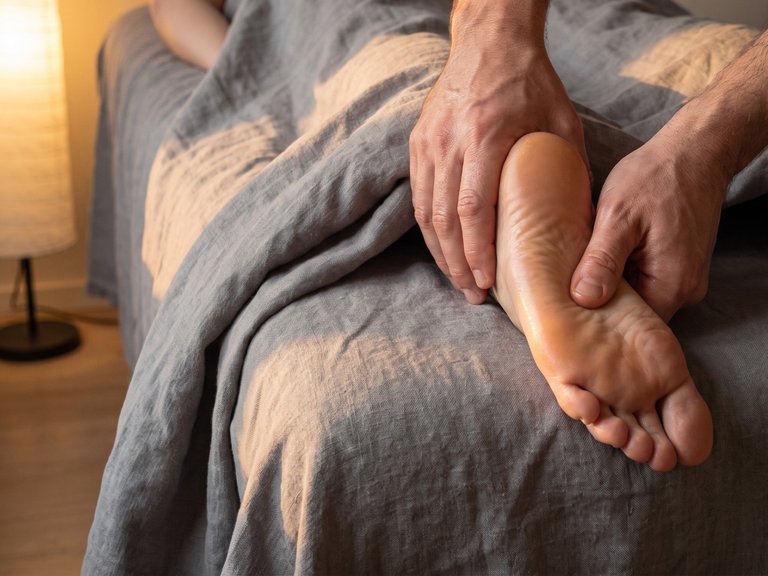
A person lies down for a massage and says everything is fine. But the fingers are cold, the toes too, sometimes the whole feet. I see it very often.
If your fingers turn white or blue in the cold and take long to recover — see a doctor. The observation leans on work by Tagawa, 2025
Catching myself with clenched teeth one minute · sitting What to do →
- Part your teeth. Rest the tip of your tongue behind your bottom teeth.
- Put your fingers in front of your ears. On the out-breath, let your jaw drop.
- Stay like this for ten to twenty seconds.
What I see at the table
I see it and sometimes ask people to let go — but a conversation never really starts. When I stand at the table and work, the person lies relaxed, feeling good, and my own teeth are clenched.
If your jaw clicks and your mouth doesn't open all the way — see a dentist. The observation leans on work by Bracci, 2018
Catching myself not breathing one minute · sitting What to do →
- Stay seated and change nothing. Slowly breathe out all the way.
- Wait for the next breath to come on its own. Don't try to make it deeper.
- Then simply stop watching how you breathe.
What I see at the table
Half a minute, maybe forty seconds — the breath seemed to stall halfway and never made it to the end. I noticed it by accident, and then started catching it all the time. Behind the wheel in heavy traffic. When I count money. When I write something that won't come.
Don't: count breaths, breathe "correctly", hold your breath. If you're short of breath even without a screen, just sitting — see a doctor. The observation leans on work by Schleifer, 2002
Didn't find yours — twenty years of observations in the channel, searchable by word
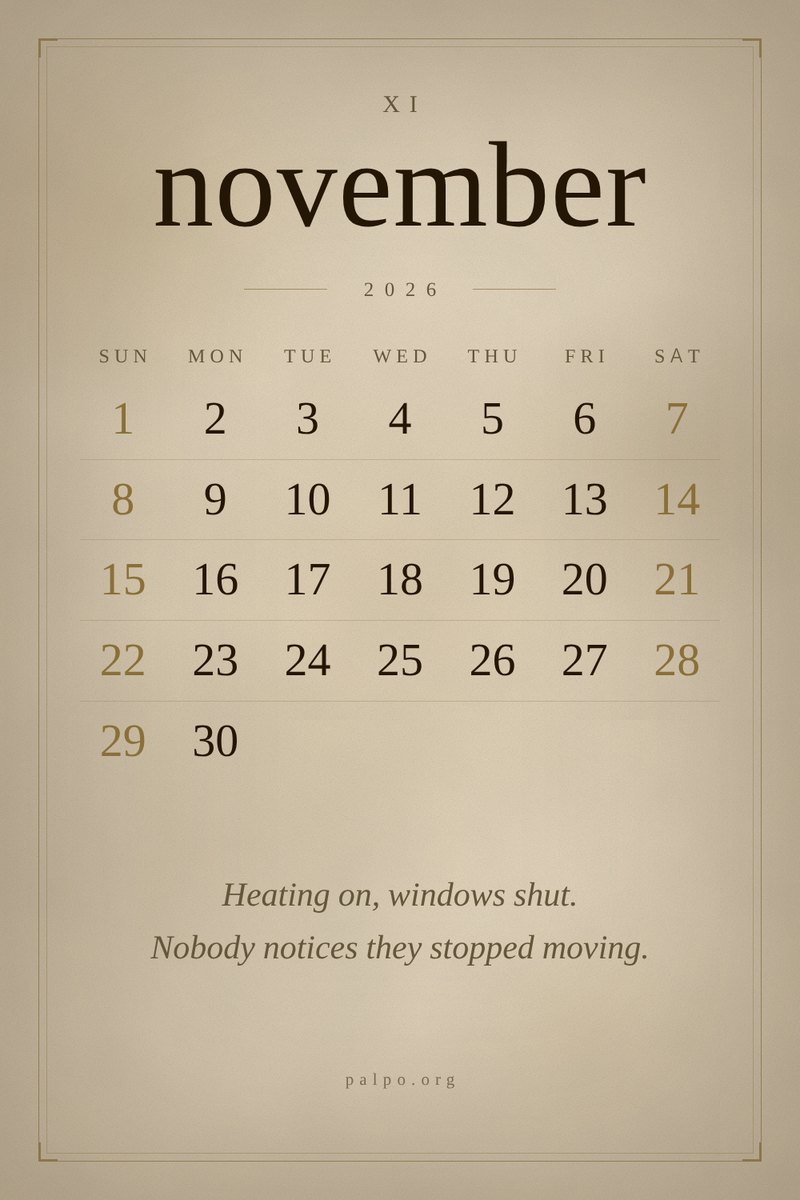
A calendar where the numbers are part of the picture
Made for a phone screen. Space is left at the top for the clock and at the bottom for the dock. One line of observation, which you see for thirty days running.
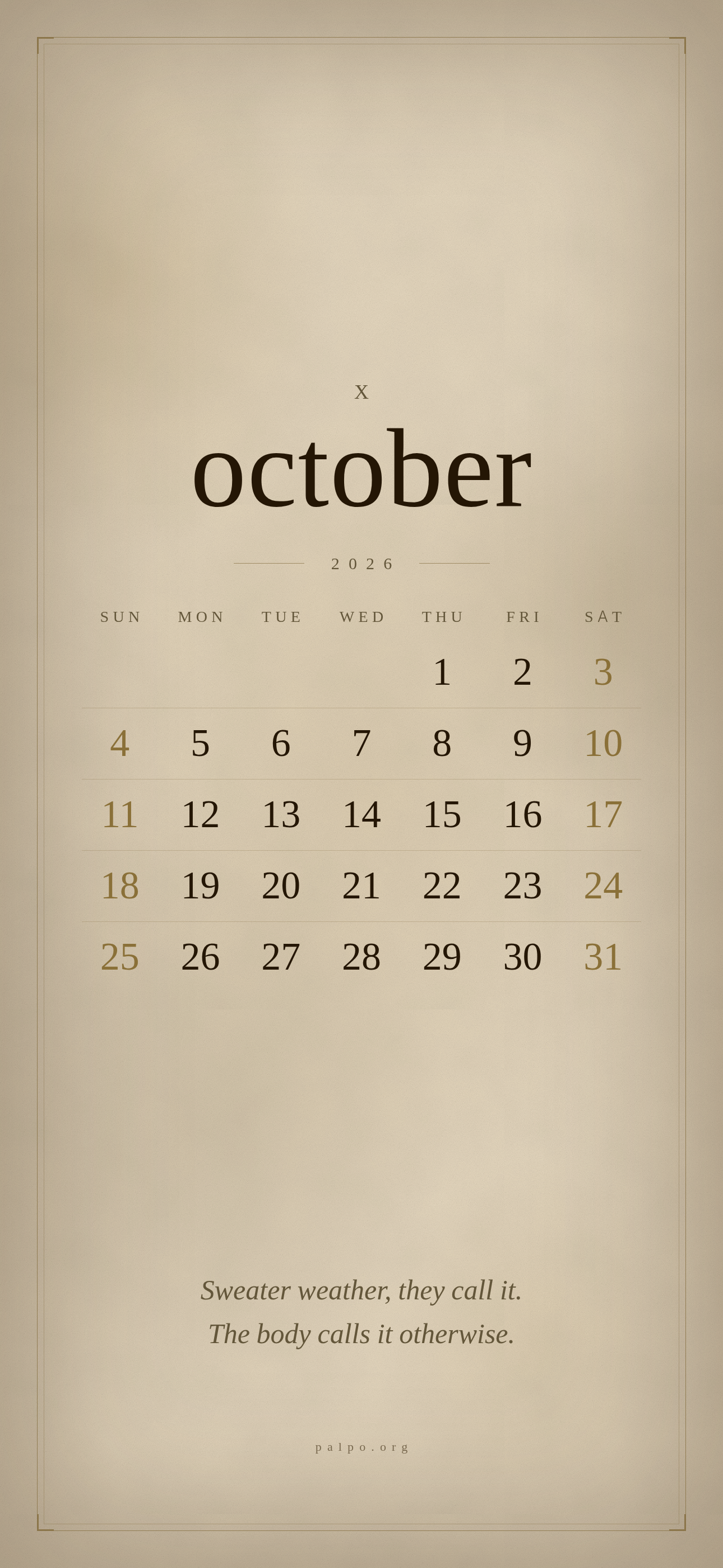
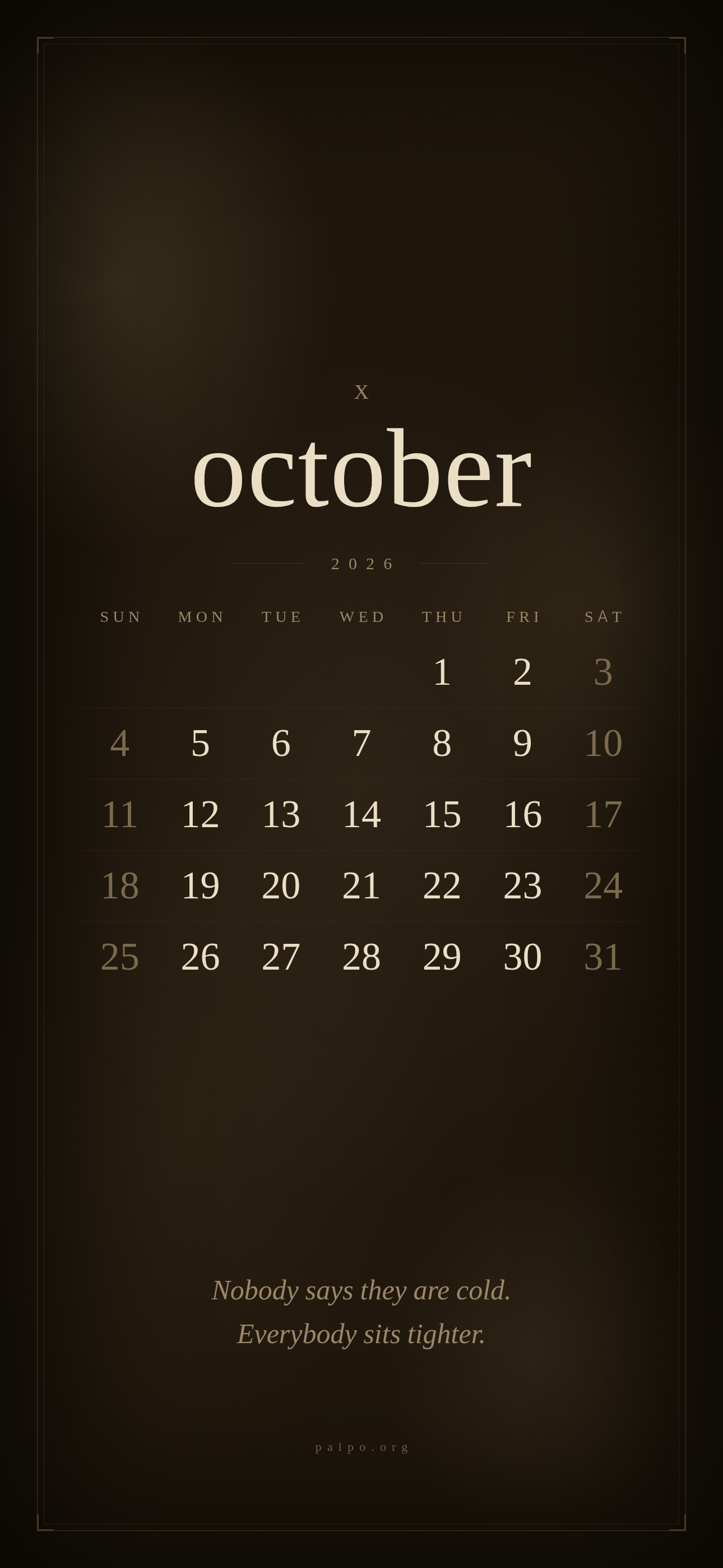
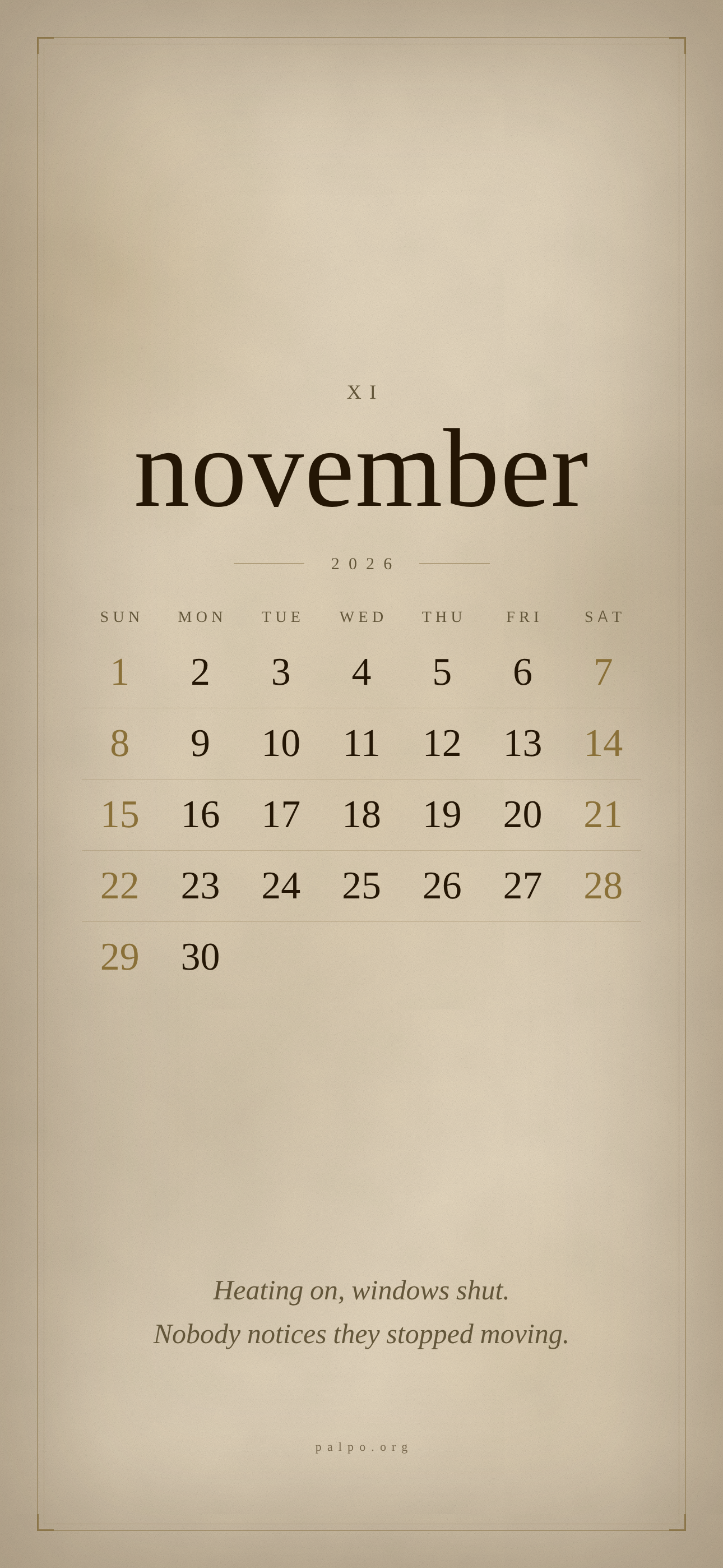
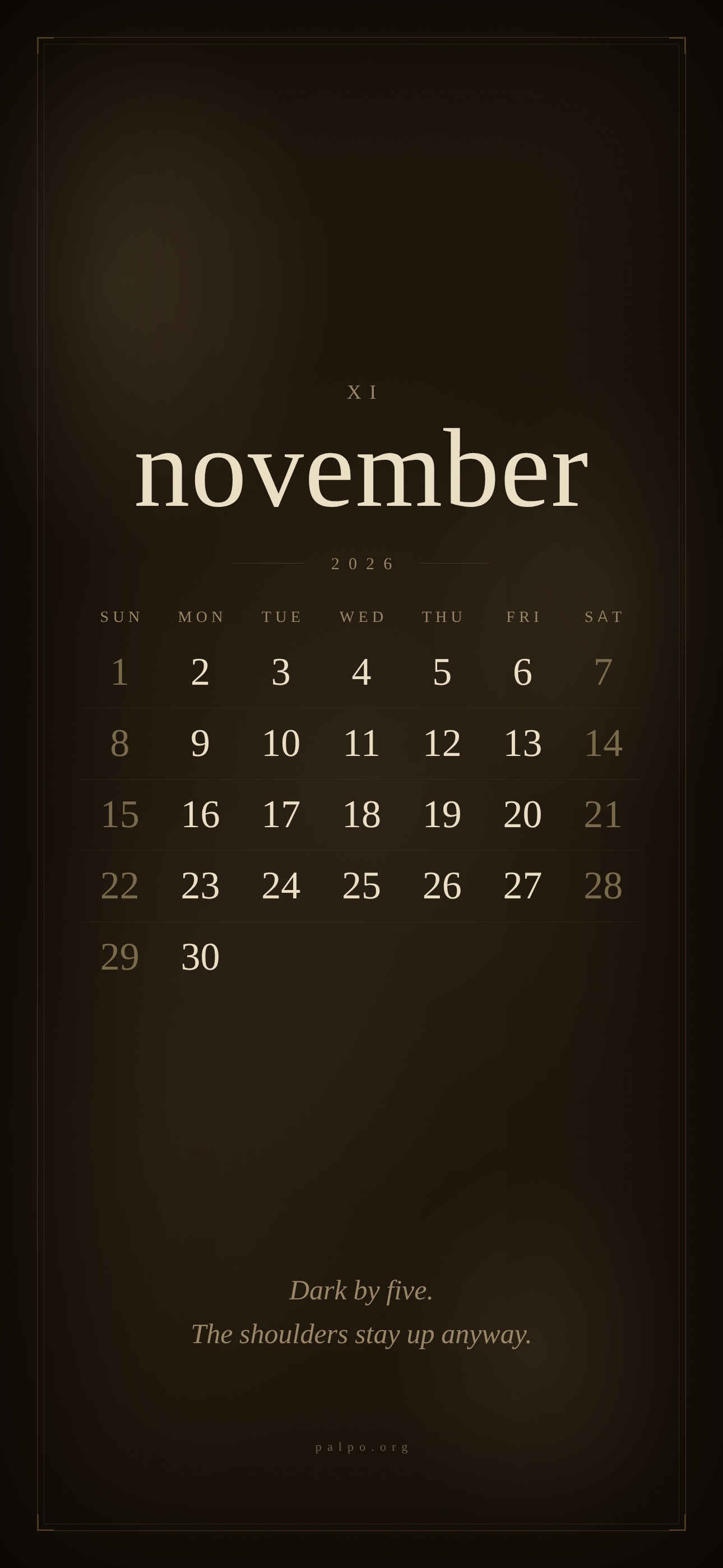
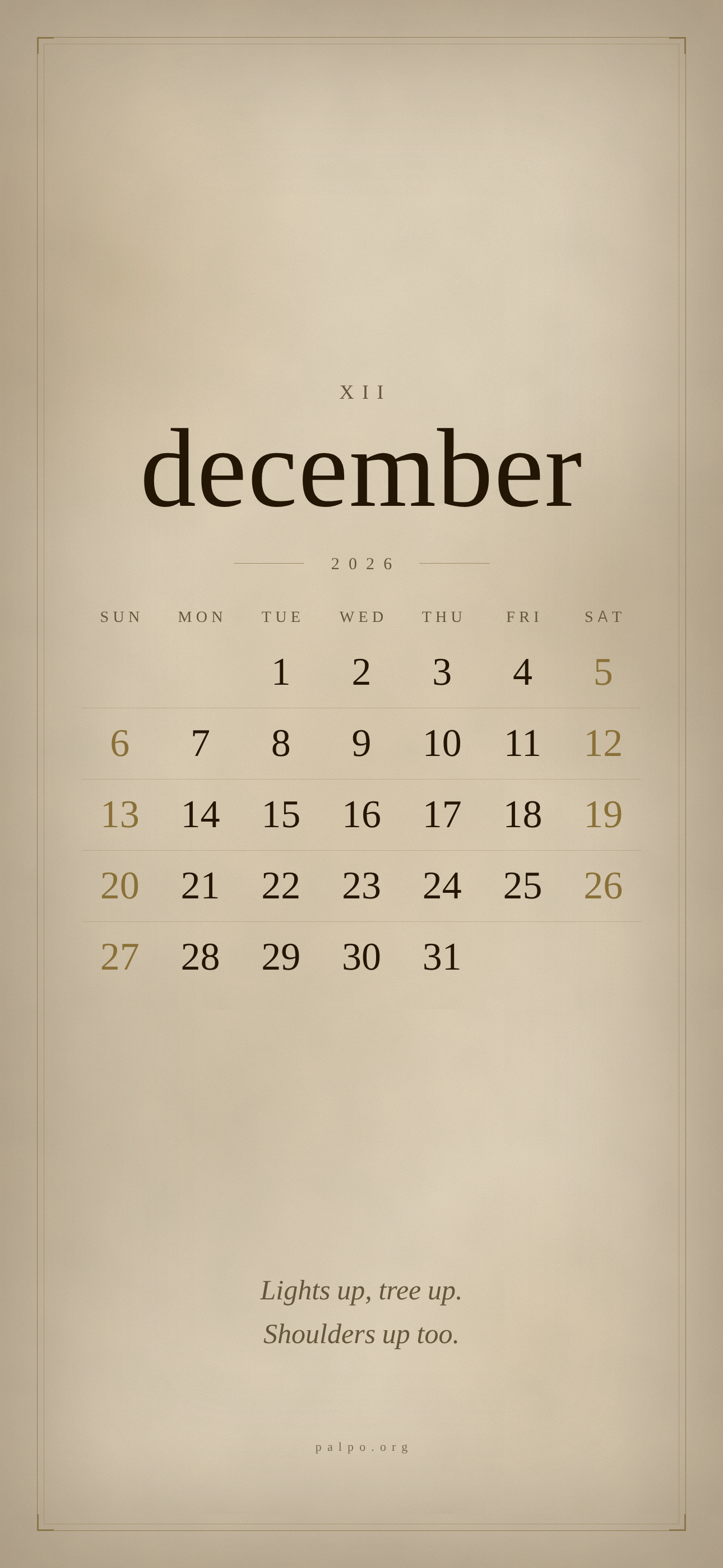
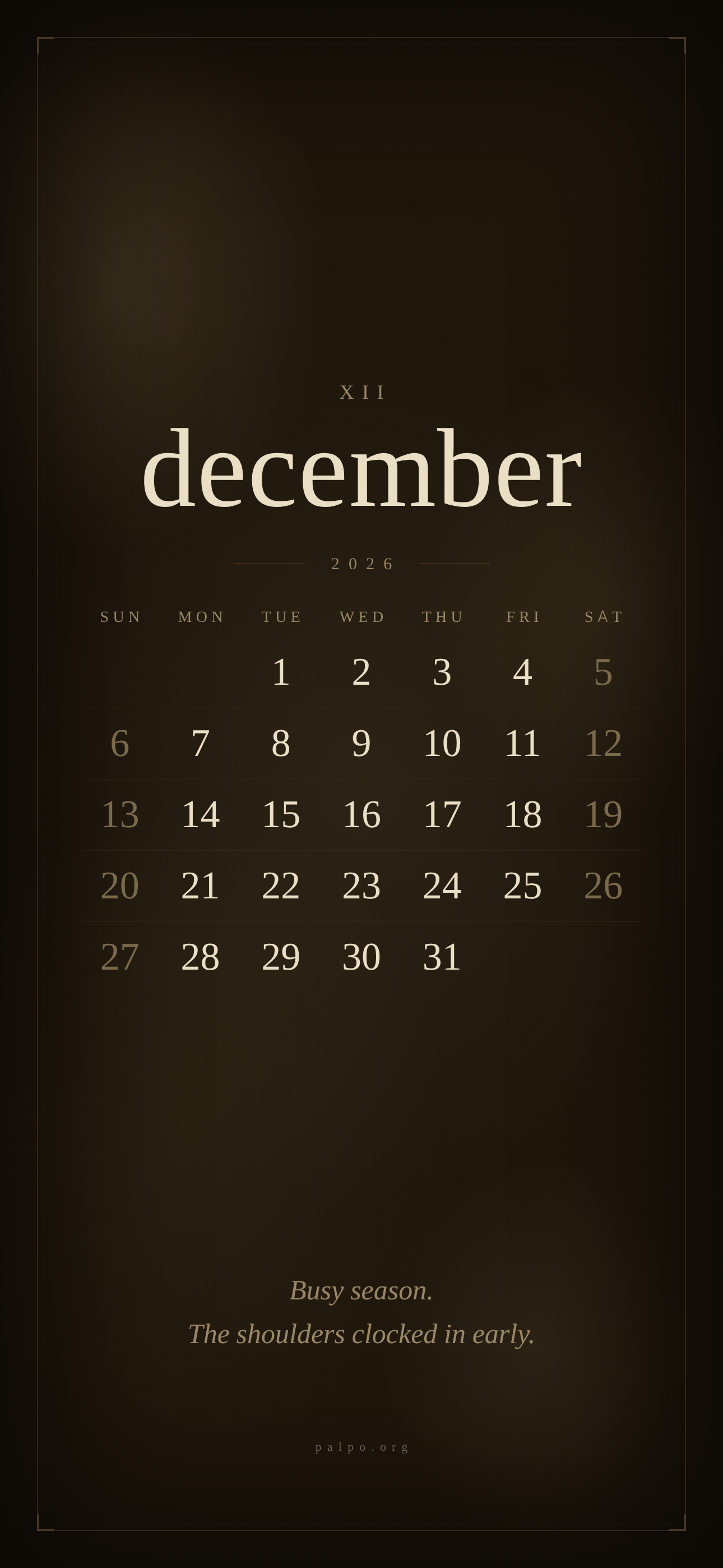
The next month appears here in advance.
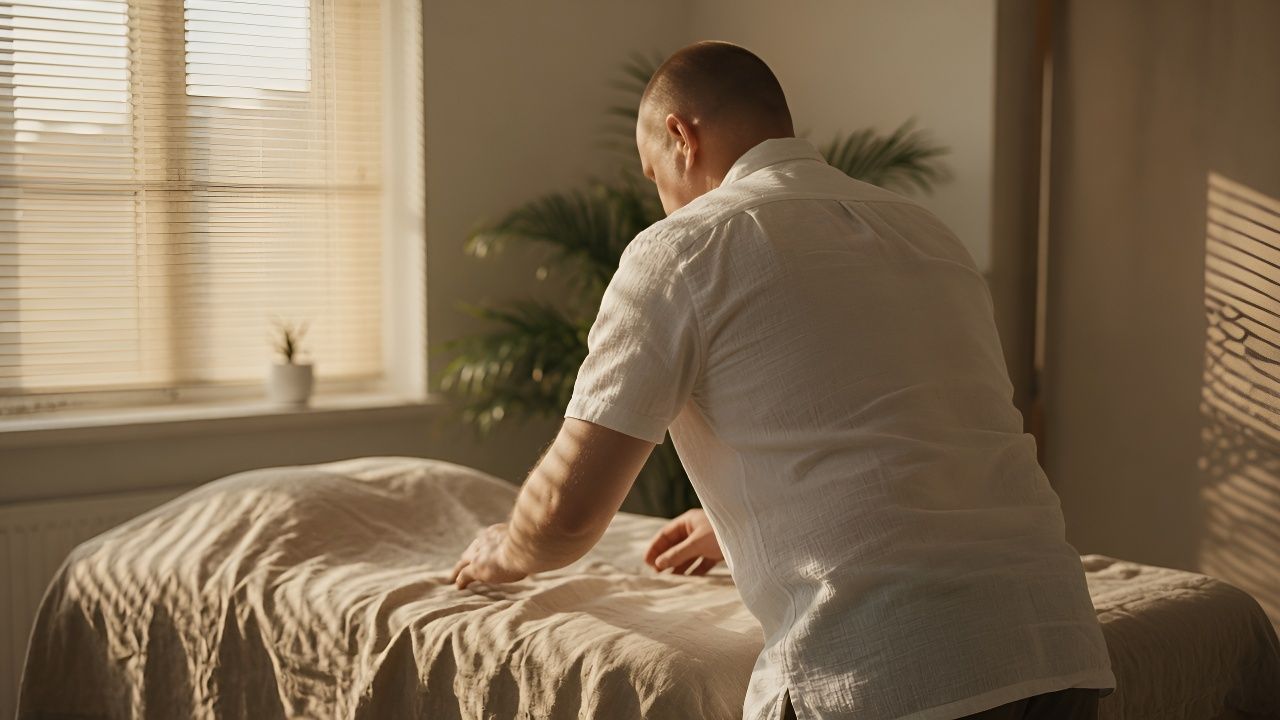
I work with my hands, but I notice with my eyes. Twenty years at the table have shown me more about bodies — and about people — than I expected. Here I put it into words. As it is, without textbooks.
New states appear every week. In the channel first.
What I actually work with
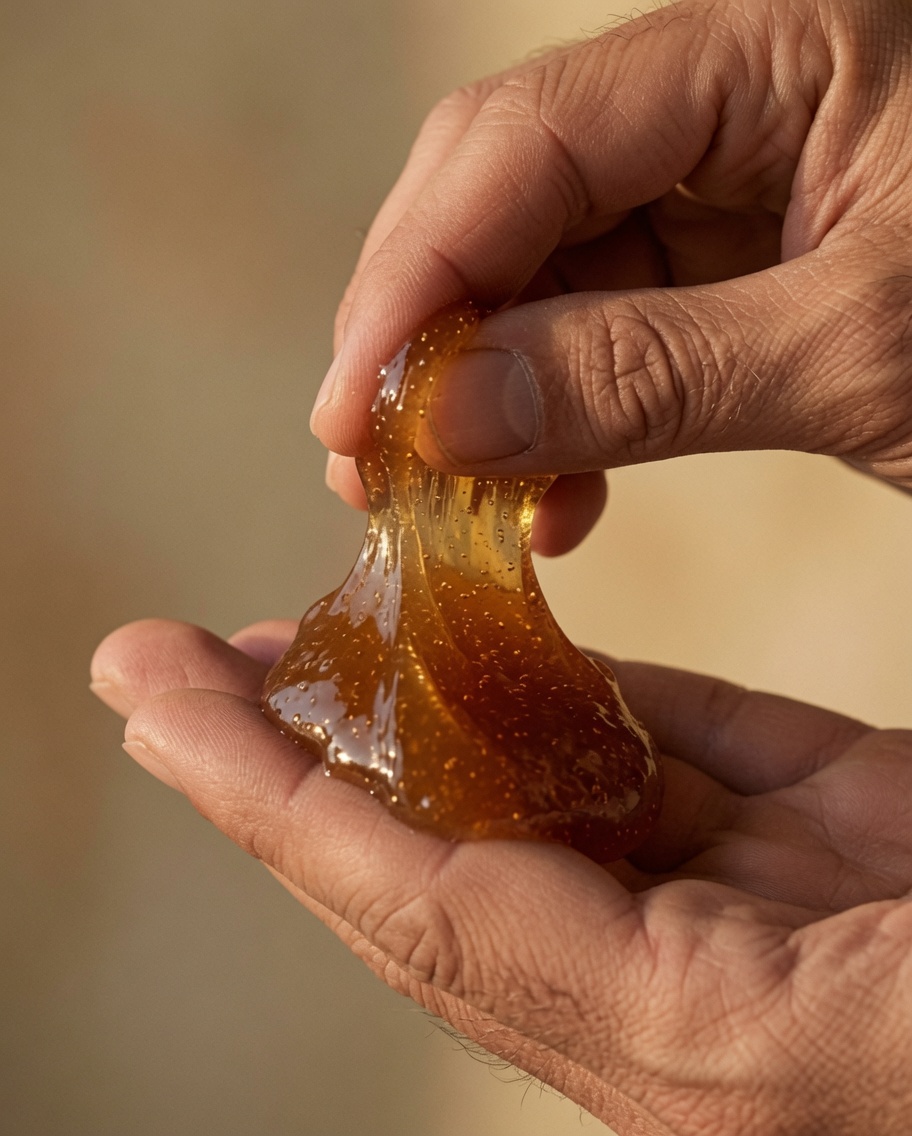
“I've kept this balm in the room for two years now. I use it before dense work — shoulders, sacrum, the deep points. Thick, it follows the finger, it doesn't run. It lasts a long time. I work with it, and I'm content.”
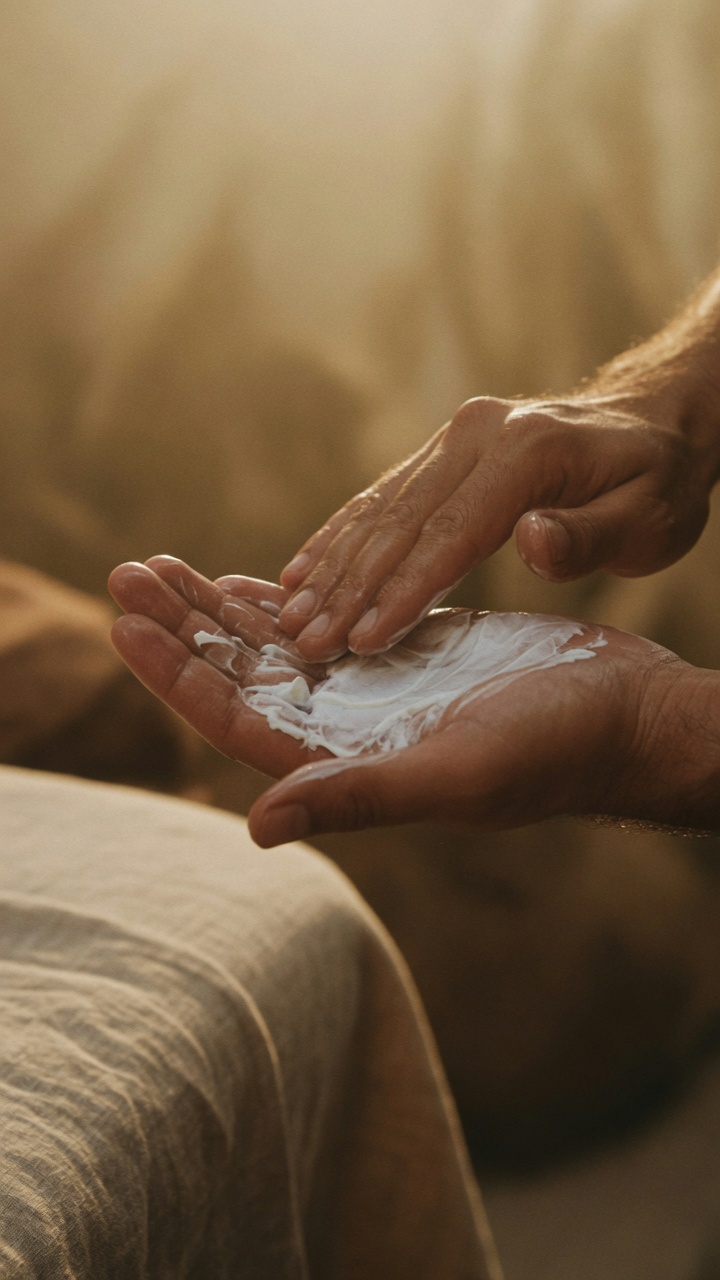
“A cream of dense texture — I can work with it for an hour and a half straight, it doesn't get sticky, it doesn't wear off. After the session the skin looks as if it had exhaled.”
Questions
What can I get here?
Your state in the list above, and a one-minute movement for it — sitting, where you are now, buying nothing. Under every state there is a line about when this is not enough and a doctor is needed.
Is this health advice?
No. I am not a doctor and do not claim to be. These are observations from the table, not medical recommendations. If something hurts, that is for a doctor. This is something else: how the body behaves, what it says when hands listen to it.
How long have you been doing this?
I came into the profession at forty. Daily at the table since 2006. Up to ten sessions a day.
Stiff lower back after sitting all day: what helps?
Sit on the edge of the chair, feet flat on the floor. Slowly rock the pelvis forward — and let it come back. The movement is small, barely visible to the eye. Five or six times, without effort. The back finds by itself where to let go. If it wakes you at night and the morning is worse than the evening was — see a doctor. The state on this page: “Stiff lower back from sitting”.
Heavy legs after sitting all day: what helps?
Curl your toes for five seconds — and release. Shift your weight onto the heels, lifting the toes off the floor. Pull the foot firmly towards you. Ten rolls. If the swelling is in one leg only, or comes with heat or a sharp bursting pain — see a doctor. The state on this page: “Legs heavy by evening”.
Shoulders up to my ears: how do I relax them?
Put your palms on the table. On the exhale press the palms down — and release after four seconds. The shoulders drop by themselves. Three times, between tasks. If lowering the shoulder sends a sharp shooting pain into the fingers, or the neck has locked — see a doctor. The state on this page: “Shoulders up to the ears”.
Fingers always cold, even in a warm room: what can I do?
Slowly make fists and curl your toes at the same time. On the out-breath, spread them wide. Ten times. Then circle your feet one way and the other. If your fingers turn white or blue in the cold and take long to recover — see a doctor. The state on this page: “Warm room, cold fingers”.
How do I stop clenching my jaw during the day?
Part your teeth. Rest the tip of your tongue behind your bottom teeth. Put your fingers in front of your ears. On the out-breath, let your jaw drop. Stay like this for ten to twenty seconds. If your jaw clicks and your mouth doesn't open all the way — see a dentist. The state on this page: “Catching myself with clenched teeth”.
Forgetting to breathe at my desk: what can I do?
Stay seated and change nothing. Slowly breathe out all the way. Wait for the next breath to come on its own. Don't try to make it deeper. Then simply stop watching how you breathe. Don't: count breaths, breathe "correctly", hold your breath. If you're short of breath even without a screen, just sitting — see a doctor. The state on this page: “Catching myself not breathing”.
What is the Shelf?
A section about the objects I work with: oils, tools, textiles. Not advertising — observations on how a specific thing changes the work. I only write about what I actually use.
Why do you use Pinterest?
Because it is search, not a feed. Someone looks up what shoulder tension is, or what a massage room looks like, and ends up here. Pinterest moves slowly and it lasts. A pin published a year ago still works today.
Atmosphere
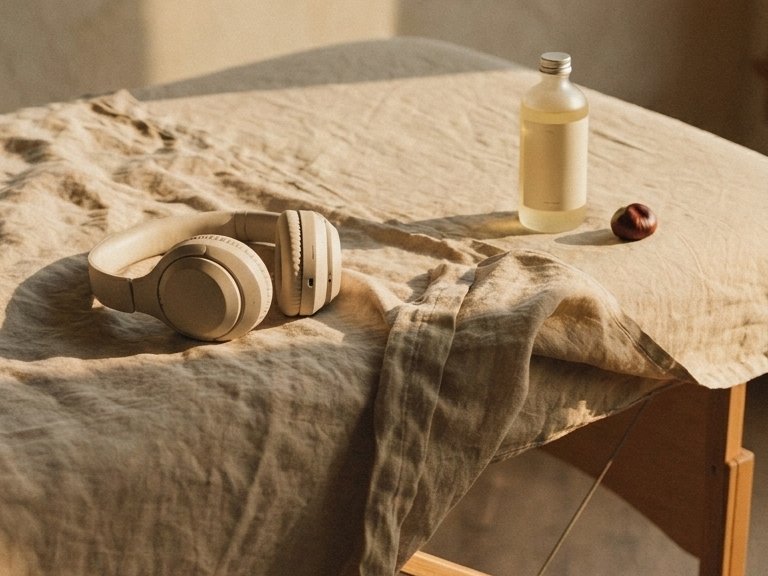
“I like the moment between sessions, when the room is empty. Light, oil, the edge of the table. Everything in its place. And nothing is needed.”